<?xml version="1.0" encoding="utf-8"?><feed xmlns="http://www.w3.org/2005/Atom" xml:lang="en"><generator uri="https://jekyllrb.com/" version="3.10.0">Jekyll</generator><link href="https://scheme-decyder.github.io//feed.xml" rel="self" type="application/atom+xml" /><link href="https://scheme-decyder.github.io//" rel="alternate" type="text/html" hreflang="en" /><updated>2025-09-30T12:08:16+00:00</updated><id>https://scheme-decyder.github.io//feed.xml</id><title type="html">Scheme Decyder</title><subtitle>A miniature painting, RPG, and programming blog. Hopefully with some intersections of the three.</subtitle><author><name>Decyne</name></author><entry><title type="html">Trying new painting techniques - sponging</title><link href="https://scheme-decyder.github.io//miniatures/miniature-painting/warmachine/2025/05/25/khymera-scheme/" rel="alternate" type="text/html" title="Trying new painting techniques - sponging" /><published>2025-05-25T00:00:00+00:00</published><updated>2025-05-25T00:00:00+00:00</updated><id>https://scheme-decyder.github.io//miniatures/miniature-painting/warmachine/2025/05/25/khymera-scheme</id><content type="html" xml:base="https://scheme-decyder.github.io//miniatures/miniature-painting/warmachine/2025/05/25/khymera-scheme/"><![CDATA[<p>One of my favourite parts of the hobby is to try out new painting techniques. I really enjoy taking techniques and trying to optimise for the best result with the least time. Currently the newest fad seems to be using makeup sponges to achieve gradients (I’ve linked a video below demonstrating the technique). Let’s see what we can do with them, when compared to airbrushes (the most common comparison):</p>

<p>Advantages:</p>
<ul>
  <li>Cheaper</li>
  <li>Easier to avoid overspray</li>
</ul>

<p>Disadvantages:</p>
<ul>
  <li>Not as smooth transitions</li>
  <li>Hard to reach crevices</li>
</ul>

<p>Advantage or Disadvantage?</p>
<ul>
  <li>Leaves a speckled, textured finish</li>
</ul>

<div class="plyr__video-embed" id="player">
  <iframe src="https://www.youtube.com/embed/R6ogE6Ae4fg?iv_load_policy=3&amp;modestbranding=1&amp;playsinline=1&amp;showinfo=0&amp;rel=0&amp;enablejsapi=1;loading=lazy" allowfullscreen="" allowtransparency="" allow="autoplay"></iframe>
</div>

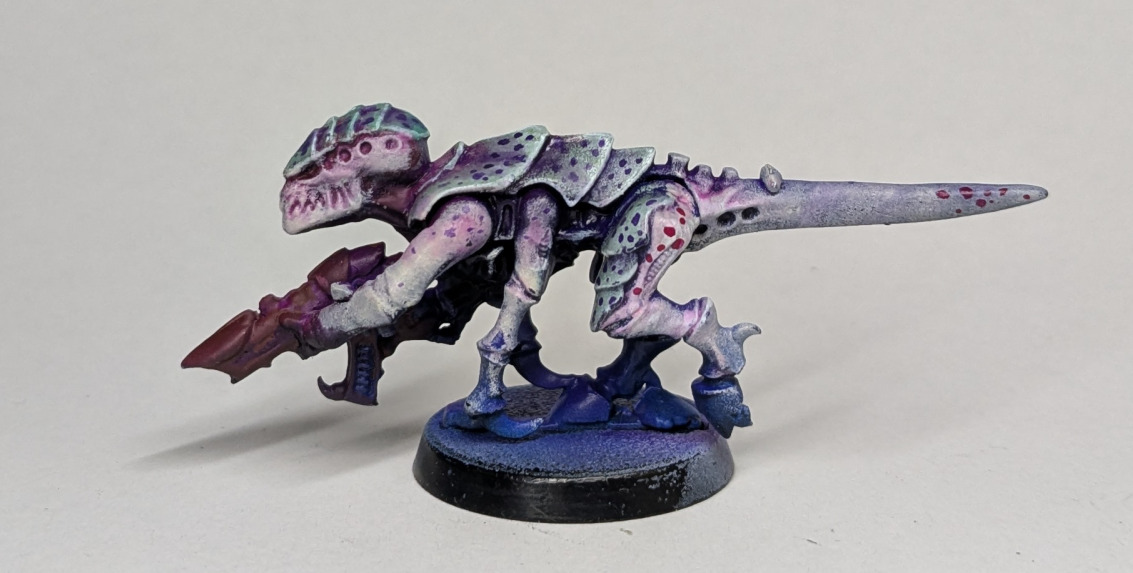
<p>So, how can we maximise the benefits and reduce the downsides of makeup sponges? My first thought is that sponging is good for models with two large surfaces of different colours. Airbrushes struggle with this because of the overspray, but sponges are a bit easier to control. With sponges, it’s hard to get in the recesses to get a solid base coat. However, what if we want colours underneath to show through? Another speed painting technique is <a href="https://www.youtube.com/watch?v=xN4dmct5Vuk" class="glightbox">underpainting with interesting colours</a>, then only painting highlights, leaving the recesses as the underpaint. This reduces the amount of brushstrokes. We could combine sponging over the top of this, the sponge won’t apply paint to the recesses, leaving the interesting undertone visible. I tested this on a random model and you can see the results below.</p>

<p><a href="/assets/image/khymera-scheme/testmodel.jpg" class="glightbox"><img src="/assets/image/khymera-scheme/testmodel.jpg" alt="test_model" /></a></p>

<p>When starting a new paint scheme, I find it useful to define what I want the model/army to look like before I put any paint on it, both in terms of theme and quality. I want this army to look like they’ve just emerged from dark, subterranean tunnels. For quality, I’m aiming for a striking tabletop quality with lots of contrast, without being the technically best I can execute. Mainly I want to get a model where the basecoats and ‘boring stuff’s are done quickly. However I don’t mind spending a bit more time adding cool details and colour. With that in mind, lets get started.</p>

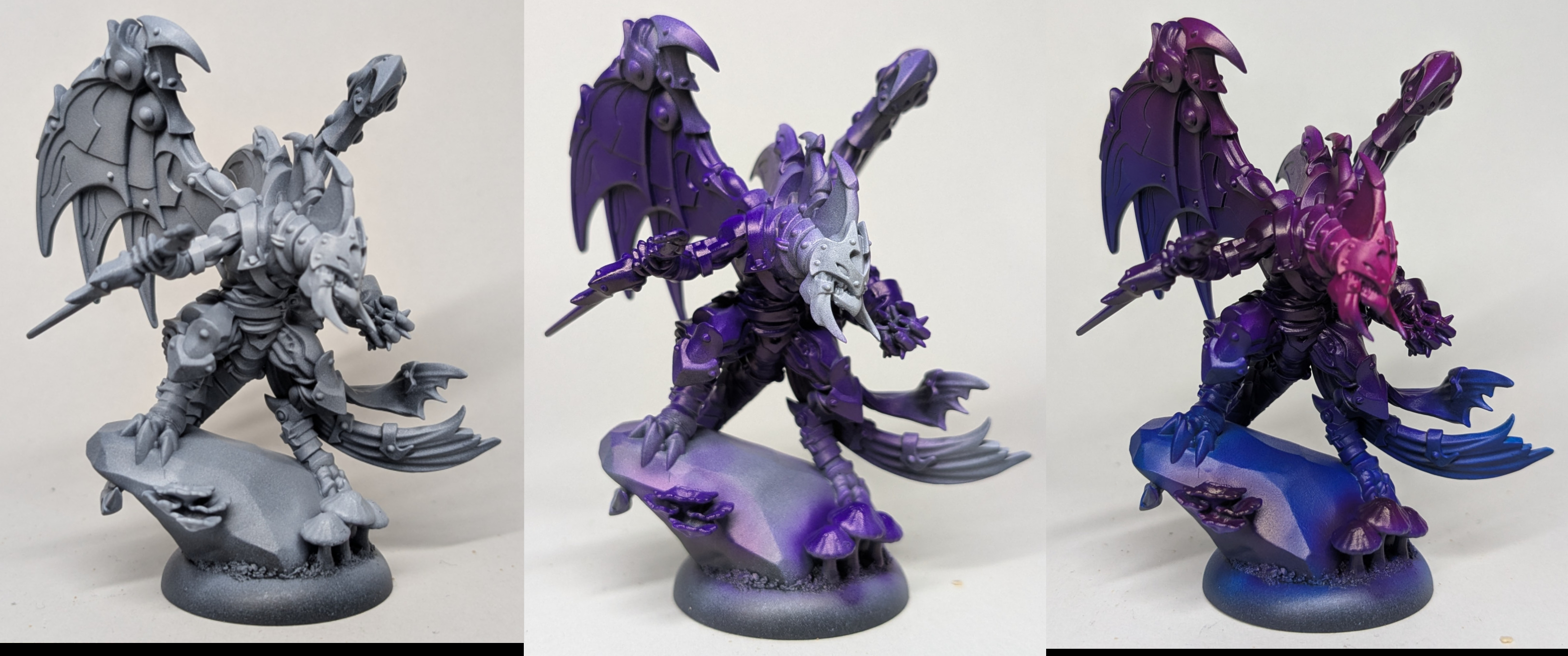
<p>First I wanted to create the interesting underpainting using my airbrush. I decided on blue -&gt; purple -&gt; magenta shift from the linked video because I already know that it looks good. From a black -&gt; white zenithal, I applied purple on the body and middle of the wings. I started with this because I wanted to make sure the model was primarily purple. In addition, I also put purple on the mushrooms because they will be glowing. With your main colour, it’s usually best to cover more of the model than you think, since the next steps will start to obscure or tint it.. Creating a smooth gradient is a bit tricky but worth it. I used purple ink with a decent amount of airbrush thinner. The magenta was placed on the focus areas of the model, the head and the top of the wings. Lastly, blue was added to the ‘boring’ bits like the base and bottom of the model.</p>

<p><a href="/assets/image/khymera-scheme/transition.jpg" class="glightbox"><img src="/assets/image/khymera-scheme/transition.jpg" alt="underpainting_transition" /></a></p>

<p>Yeah I know, it’s a bit ironic that I used an airbrush as the first step, where one of the alleged ‘advantages’ of the makeup sponge technique is that you don’t need an airbrush. But I think the sponging offers enough in this case that it’s worth using it.</p>

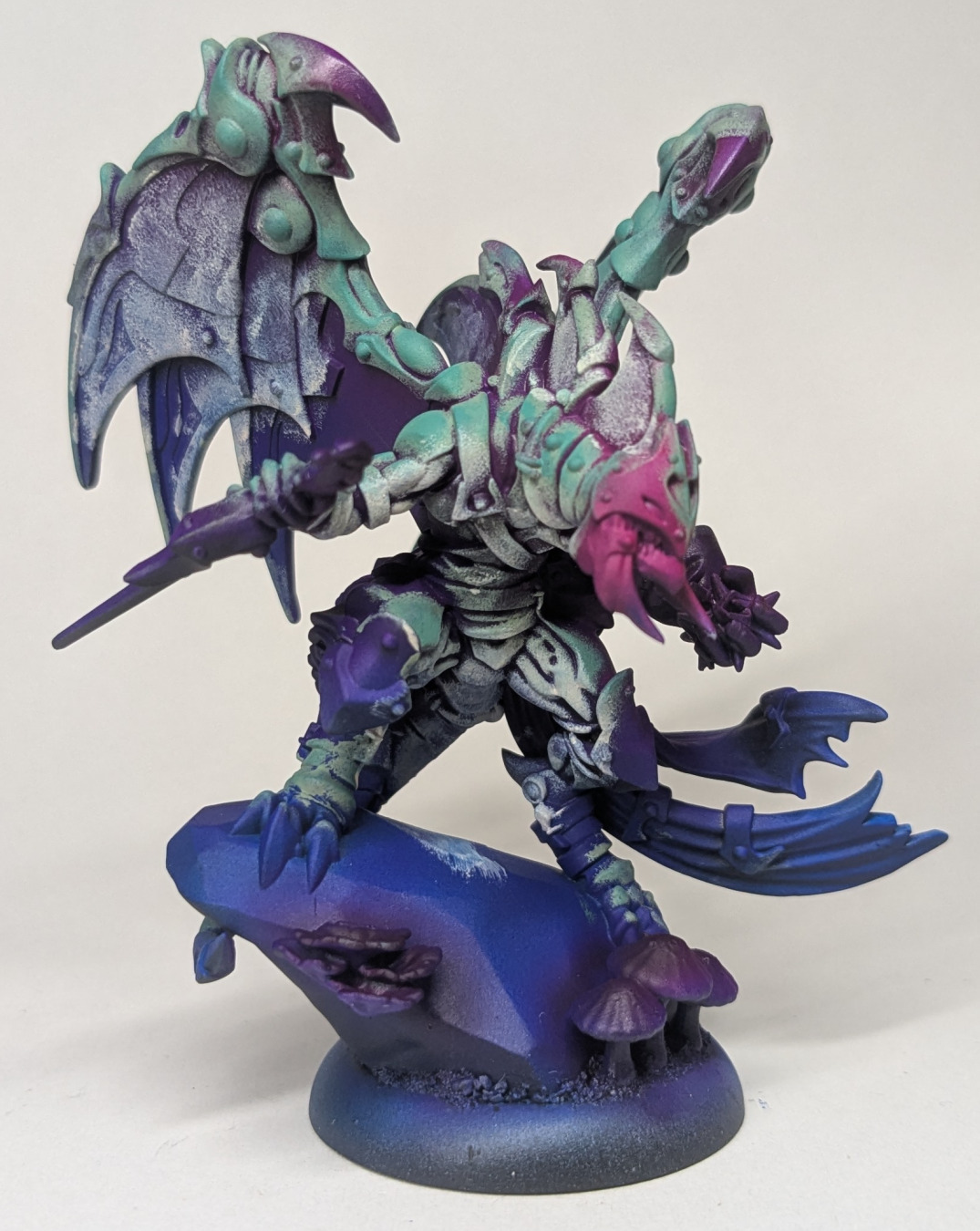
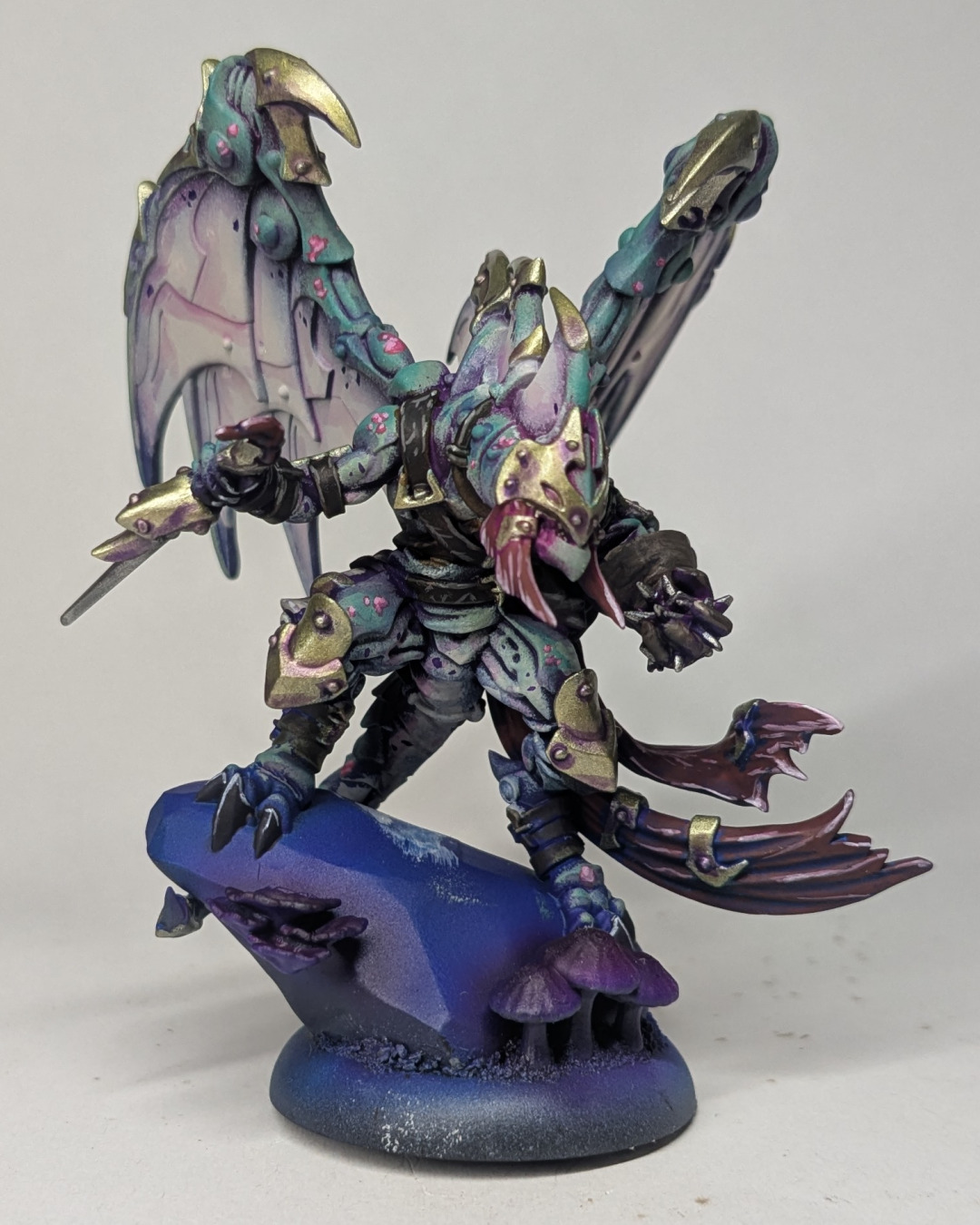
<p>I sponged on some desaturated green on the scales, and some off white on the underbelly. I also ended up sponging on some more saturated jade on top of the desaturated green because I thought the test model above didn’t have enough contrast between the scales and the underbelly. However the sponging didn’t go so well on the large, flat wings…</p>

<p><a href="/assets/image/khymera-scheme/firstgreen.jpg" class="glightbox"><img src="/assets/image/khymera-scheme/firstgreen.jpg" alt="sponging" /></a></p>

<p>The reason I think the sponging works, on this model in particular, is because this model is made up of lots of little flat panels (notice that Trovarion’s miniature in the video at the start is similar). Tapping the sponge highlights the top of the panel while leaving the bottom the interesting undertone. I think this is more effective than other ‘fast’ methods. If I used contrast paints, the top of the panels are too flat and the paint would pool. If I airbrushed I would lose the shadows and undertones. That being said, I did end up airbrushing the wings. Let’s keep going and fill in most of the details.</p>

<p><a href="/assets/image/khymera-scheme/gold.jpg" class="glightbox"><img src="/assets/image/khymera-scheme/gold.jpg" alt="sponging" /></a></p>

<p>So, most of the way there. Let’s take a step back and see how we feel. Compared to the initial test model, I changed from purple spots on the scales to pink spots. I’m unsure if this pops too much, I might go midway and try a dark magenta next. I would also make the purple spots on the underbelly/wings more transparent next time. We’re getting close, just highlights, base and finishing touches.</p>

<p><a href="/assets/image/khymera-scheme/final.jpg" class="glightbox"><img src="/assets/image/khymera-scheme/final.jpg" alt="final_model" /></a></p>

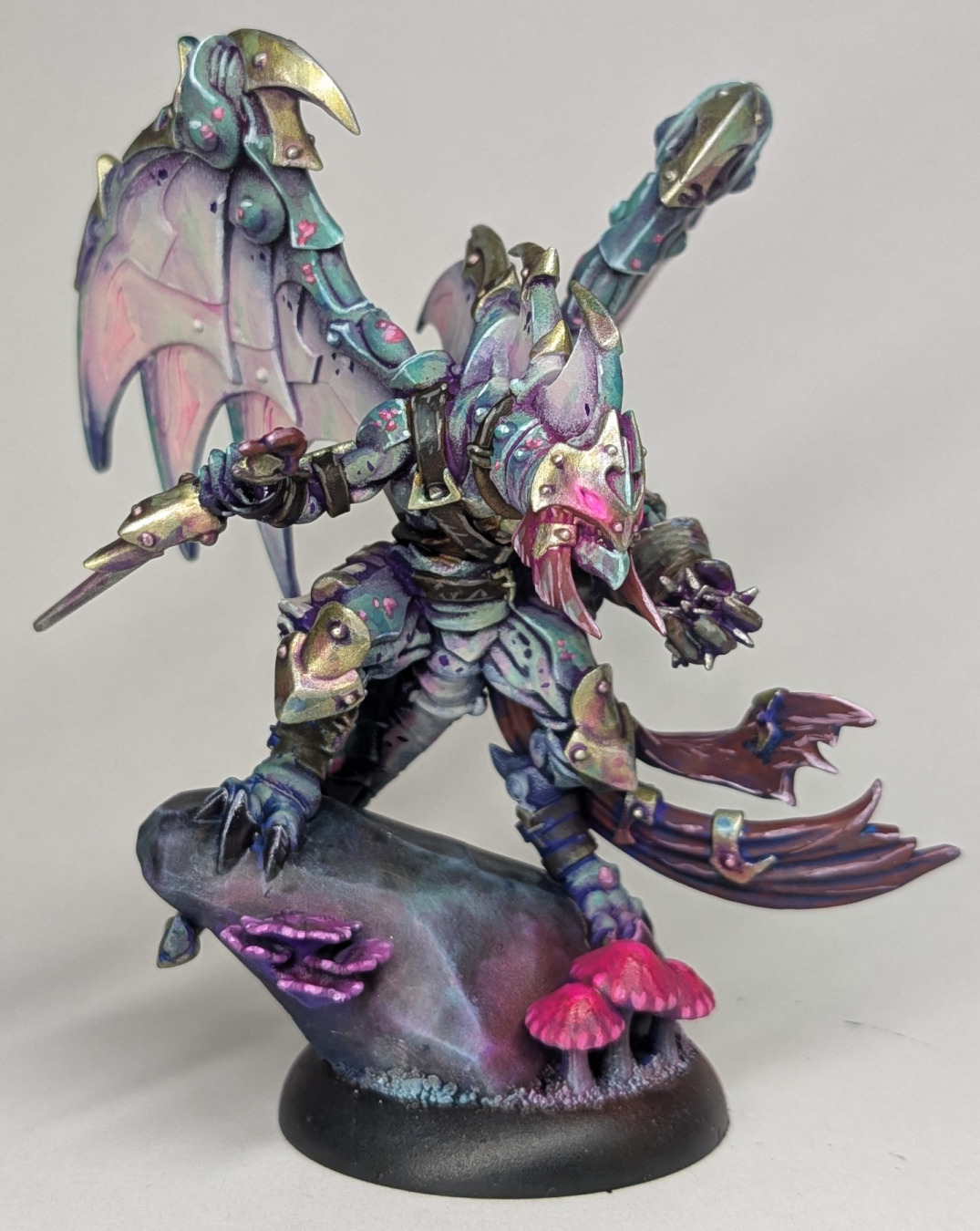
<p>All done! I really like how the scales came out. The blends from the underbelly, to the desaturated green, to the saturated jade came out really well, and the sponge texture lends itself to natural, mottled scales. The sponging did a great job of leaving the undertones in the recesses of the scales. I found that the transition from the white-ish underbelly, to the scales looks natural while still having some definition, it doesn’t have the ‘fuzzing’ like an airbrush would. In addition, <a href="https://steamforged.com/products/warmachine-shadows-and-scum">these models</a> are notorious for the different materials being hard to define. With this method I was able to ignore that and just sponge. I left anything I was unsure about, or anything in a hard to see place, in the underpaint colour, and it still looked painted.</p>

<p>In terms of getting the rest of the model done, I also really enjoy not putting paint on the shadows for places like the cloth, just letting the underpainting show through. It feels like I’m not wasting time, I only need to paint the minimum number of layers. I also glazed a lot of colours from my palette all over the model, especially on the metals, representing light bouncing and reflecting on the surfaces. It’s something I’ve been looking at incorporating into this army. It makes the model look more interesting, but ultimately, it’s just fun to do.</p>

<p>In summary, it definitely wasn’t a speedpaint job. Around five painting sessions, but I was doing a lot of experimenting. However I did feel like I achieved my goal set out at the start, the boring bits were over quickly and I had a really enjoyable time painting this model. I’m looking forward to getting more models painted up in this scheme!</p>]]></content><author><name>Decyne</name></author><category term="miniatures" /><category term="miniature-painting" /><category term="warmachine" /><summary type="html"><![CDATA[One of my favourite parts of the hobby is to try out new painting techniques. I really enjoy taking techniques and trying to optimise for the best result with the least time. Currently the newest fad seems to be using makeup sponges to achieve gradients (I’ve linked a video below demonstrating the technique). Let’s see what we can do with them, when compared to airbrushes (the most common comparison): Advantages: Cheaper Easier to avoid overspray Disadvantages: Not as smooth transitions Hard to reach crevices Advantage or Disadvantage? Leaves a speckled, textured finish So, how can we maximise the benefits and reduce the downsides of makeup sponges? My first thought is that sponging is good for models with two large surfaces of different colours. Airbrushes struggle with this because of the overspray, but sponges are a bit easier to control. With sponges, it’s hard to get in the recesses to get a solid base coat. However, what if we want colours underneath to show through? Another speed painting technique is underpainting with interesting colours, then only painting highlights, leaving the recesses as the underpaint. This reduces the amount of brushstrokes. We could combine sponging over the top of this, the sponge won’t apply paint to the recesses, leaving the interesting undertone visible. I tested this on a random model and you can see the results below. When starting a new paint scheme, I find it useful to define what I want the model/army to look like before I put any paint on it, both in terms of theme and quality. I want this army to look like they’ve just emerged from dark, subterranean tunnels. For quality, I’m aiming for a striking tabletop quality with lots of contrast, without being the technically best I can execute. Mainly I want to get a model where the basecoats and ‘boring stuff’s are done quickly. However I don’t mind spending a bit more time adding cool details and colour. With that in mind, lets get started. First I wanted to create the interesting underpainting using my airbrush. I decided on blue -&gt; purple -&gt; magenta shift from the linked video because I already know that it looks good. From a black -&gt; white zenithal, I applied purple on the body and middle of the wings. I started with this because I wanted to make sure the model was primarily purple. In addition, I also put purple on the mushrooms because they will be glowing. With your main colour, it’s usually best to cover more of the model than you think, since the next steps will start to obscure or tint it.. Creating a smooth gradient is a bit tricky but worth it. I used purple ink with a decent amount of airbrush thinner. The magenta was placed on the focus areas of the model, the head and the top of the wings. Lastly, blue was added to the ‘boring’ bits like the base and bottom of the model. Yeah I know, it’s a bit ironic that I used an airbrush as the first step, where one of the alleged ‘advantages’ of the makeup sponge technique is that you don’t need an airbrush. But I think the sponging offers enough in this case that it’s worth using it. I sponged on some desaturated green on the scales, and some off white on the underbelly. I also ended up sponging on some more saturated jade on top of the desaturated green because I thought the test model above didn’t have enough contrast between the scales and the underbelly. However the sponging didn’t go so well on the large, flat wings… The reason I think the sponging works, on this model in particular, is because this model is made up of lots of little flat panels (notice that Trovarion’s miniature in the video at the start is similar). Tapping the sponge highlights the top of the panel while leaving the bottom the interesting undertone. I think this is more effective than other ‘fast’ methods. If I used contrast paints, the top of the panels are too flat and the paint would pool. If I airbrushed I would lose the shadows and undertones. That being said, I did end up airbrushing the wings. Let’s keep going and fill in most of the details. So, most of the way there. Let’s take a step back and see how we feel. Compared to the initial test model, I changed from purple spots on the scales to pink spots. I’m unsure if this pops too much, I might go midway and try a dark magenta next. I would also make the purple spots on the underbelly/wings more transparent next time. We’re getting close, just highlights, base and finishing touches. All done! I really like how the scales came out. The blends from the underbelly, to the desaturated green, to the saturated jade came out really well, and the sponge texture lends itself to natural, mottled scales. The sponging did a great job of leaving the undertones in the recesses of the scales. I found that the transition from the white-ish underbelly, to the scales looks natural while still having some definition, it doesn’t have the ‘fuzzing’ like an airbrush would. In addition, these models are notorious for the different materials being hard to define. With this method I was able to ignore that and just sponge. I left anything I was unsure about, or anything in a hard to see place, in the underpaint colour, and it still looked painted. In terms of getting the rest of the model done, I also really enjoy not putting paint on the shadows for places like the cloth, just letting the underpainting show through. It feels like I’m not wasting time, I only need to paint the minimum number of layers. I also glazed a lot of colours from my palette all over the model, especially on the metals, representing light bouncing and reflecting on the surfaces. It’s something I’ve been looking at incorporating into this army. It makes the model look more interesting, but ultimately, it’s just fun to do. In summary, it definitely wasn’t a speedpaint job. Around five painting sessions, but I was doing a lot of experimenting. However I did feel like I achieved my goal set out at the start, the boring bits were over quickly and I had a really enjoyable time painting this model. I’m looking forward to getting more models painted up in this scheme!]]></summary></entry><entry><title type="html">Formatting pretty hex keys from template text files</title><link href="https://scheme-decyder.github.io//rpg/layout/latex/2023/02/21/Hex-Templates/" rel="alternate" type="text/html" title="Formatting pretty hex keys from template text files" /><published>2023-02-21T00:00:00+00:00</published><updated>2023-02-21T00:00:00+00:00</updated><id>https://scheme-decyder.github.io//rpg/layout/latex/2023/02/21/Hex-Templates</id><content type="html" xml:base="https://scheme-decyder.github.io//rpg/layout/latex/2023/02/21/Hex-Templates/"><![CDATA[<p class="message">This was originally posted to my other blog. However I have posted it here to consolidate all my hobby content in one place.</p>
<p>I’m really fascinated with layout and production of DnD adventures, however I don’t have the patience to sit down and fiddle in Word or Affinity Publisher. Instead I want to write my hex keys and descriptions in a standard template and get the computer to make it look attractive and lay everything out in a nice PDF document for me. For example my hex descriptions often follow the following template:</p>

<h4 id="hex-title">Hex Title</h4>
<ul>
  <li>Some descriptive bullet points</li>
  <li>Additional descriptions</li>
</ul>

<p>Hidden:</p>
<ul>
  <li>Something only found by searching</li>
</ul>

<p>I want to be able to write all my hex descriptions in something like the above template in plaintext, then compile them all into a well formatted document. What advantages does this bring rather than just writing it in a normal word processor?</p>
<ul>
  <li>Most often inspiration strikes me on the fly, and I want to write my ideas down into my phone using a basic text editor. This lets me write directly into my template file rather than writing down onto a notepad and then transcribing into a word processor later.</li>
  <li>Hexes are easily rearranged or imported. To rearrange entire hex decscriptions in the document we just change the order they’re included and the computer does the rest for us! We could even build up a large “library” of hexes and create new hex crawls by mixing and matching a bunch of different hexes.</li>
  <li>Hexes could be crowdsourced by a group, like from a forum. These standard format hexes could quickly be turned into an adventure!</li>
</ul>

<p>To create this workflow from text template files to a formatted PDF document we need a few components:</p>

<ul>
  <li><strong>Processor to create the document:</strong> I’m using LaTeX. LaTeX is a documentation preperation system that uses document markup rather than wysiwyg (like Microsoft Word).</li>
  <li><strong>A format to write the templates in:</strong> The templates need to be written in a format that can be read by a programming language. I’m using writing these in configuration files in YAML format. I like YAML as it’s human readable and easy for programming languages to parse.</li>
  <li><strong>Something to convert the template into the Processor Language:</strong> In this case I want to convert my YAML templates into LaTeX. I’m using the jinja2 templating engine with Python because its what I’m familiar with.</li>
</ul>

<p>The first thing we want to do is to convert the hex descriptions above into the YAML template. Below you can see a hex description I’ve written that roughly matches my below template.</p>

<figure class="highlight"><pre><code class="language-yml" data-lang="yml"><span class="na">hex</span><span class="pi">:</span> 
  <span class="na">name</span><span class="pi">:</span> <span class="s">Middle Bridge</span>
  <span class="na">description</span><span class="pi">:</span>
    <span class="pi">-</span> <span class="s">Two cart wide stone bridge, charred and crumbing but still standing</span>
    <span class="pi">-</span> <span class="s">Two trolls standing guard, demanding toll of 2c each to cross - easily confused</span> 
  <span class="na">hidden</span><span class="pi">:</span> 
    <span class="pi">-</span> <span class="s">Underneath bridge on west side, troll encampment. 1d6 trolls sleeping and dangling a gagged halfling over boiling pot.</span>
    <span class="pi">-</span> <span class="s">Cave crudely excavated into western bridge wall. contains 100c and a keg of dwarvern ale (bravery for 24 hours).</span></code></pre></figure>

<p>We can see that even though it has been converted to YAML it’s still readable. I would write a bunch of these hex descriptions and put each one in a seperate file.</p>

<p>Next we need to convert these descriptions to LaTeX. <a href="https://github.com/decyne/rpg-hexmap-template">The converter for this can be found on my github</a>. This code includes the required hex description files, converts them into LaTeX and then compiles the LaTeX to a pdf.</p>

<p>You may notice that I’ve included each hex statically (rather than just including all files in my hex directory). This is so I can determine the order of the hexes in the document and reorder them at any time. In the final document they will be automatically numbered and arranged in the order they were included.</p>

<p>After running this code we can have a look at the .tex file produced. This contains the LaTeX typesetting used to create the PDF. We can see that the hex descriptions are in this file and have been converted to LaTeX.</p>

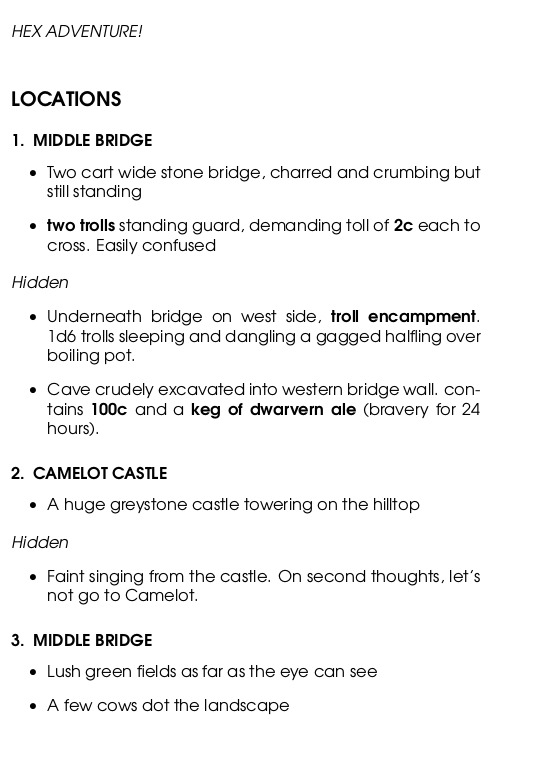
<p>Finally we can have a look at the PDF document produced by LaTeX. I’m using a <a href="https://www.dragonsfoot.org/forums/viewtopic.php?f=87&amp;t=73823">template to match old school D&amp;D adventures</a>. If you want to try out my script you will need to use this template.</p>

<p><img src="/assets/image/hex_tiles/hex_pdf.jpg" alt="PDF Output Snippet" /></p>

<p>Looks good!</p>

<p>If I was looking to publish an adventure in this style I’m sure the LaTeX markup would need some cleanup to get it in a proffessional-ish manner. However the process above should be sufficient for my home games or fast prototyping.</p>

<p>I’m looking to extend this to allow for writing an entire adventure. For example having a template for encounter tables and monster stats. What if there was a file for troll stats in one game system (eg OSE) and a file for troll stats in another (eg. ItO)? We could have a modular system where to create the adventure with different stats we just import the files for the monster stats for the system that’s being played.</p>

<p>Hopefully my ramblings were interesting. Let me know if you want to hear more and are interested in the extensions of this topic.</p>]]></content><author><name>Decyne</name></author><category term="RPG" /><category term="layout" /><category term="LaTeX" /><summary type="html"><![CDATA[This was originally posted to my other blog. However I have posted it here to consolidate all my hobby content in one place. I’m really fascinated with layout and production of DnD adventures, however I don’t have the patience to sit down and fiddle in Word or Affinity Publisher. Instead I want to write my hex keys and descriptions in a standard template and get the computer to make it look attractive and lay everything out in a nice PDF document for me. For example my hex descriptions often follow the following template: Hex Title Some descriptive bullet points Additional descriptions Hidden: Something only found by searching I want to be able to write all my hex descriptions in something like the above template in plaintext, then compile them all into a well formatted document. What advantages does this bring rather than just writing it in a normal word processor? Most often inspiration strikes me on the fly, and I want to write my ideas down into my phone using a basic text editor. This lets me write directly into my template file rather than writing down onto a notepad and then transcribing into a word processor later. Hexes are easily rearranged or imported. To rearrange entire hex decscriptions in the document we just change the order they’re included and the computer does the rest for us! We could even build up a large “library” of hexes and create new hex crawls by mixing and matching a bunch of different hexes. Hexes could be crowdsourced by a group, like from a forum. These standard format hexes could quickly be turned into an adventure! To create this workflow from text template files to a formatted PDF document we need a few components: Processor to create the document: I’m using LaTeX. LaTeX is a documentation preperation system that uses document markup rather than wysiwyg (like Microsoft Word). A format to write the templates in: The templates need to be written in a format that can be read by a programming language. I’m using writing these in configuration files in YAML format. I like YAML as it’s human readable and easy for programming languages to parse. Something to convert the template into the Processor Language: In this case I want to convert my YAML templates into LaTeX. I’m using the jinja2 templating engine with Python because its what I’m familiar with. The first thing we want to do is to convert the hex descriptions above into the YAML template. Below you can see a hex description I’ve written that roughly matches my below template. hex: name: Middle Bridge description: - Two cart wide stone bridge, charred and crumbing but still standing - Two trolls standing guard, demanding toll of 2c each to cross - easily confused hidden: - Underneath bridge on west side, troll encampment. 1d6 trolls sleeping and dangling a gagged halfling over boiling pot. - Cave crudely excavated into western bridge wall. contains 100c and a keg of dwarvern ale (bravery for 24 hours). We can see that even though it has been converted to YAML it’s still readable. I would write a bunch of these hex descriptions and put each one in a seperate file. Next we need to convert these descriptions to LaTeX. The converter for this can be found on my github. This code includes the required hex description files, converts them into LaTeX and then compiles the LaTeX to a pdf. You may notice that I’ve included each hex statically (rather than just including all files in my hex directory). This is so I can determine the order of the hexes in the document and reorder them at any time. In the final document they will be automatically numbered and arranged in the order they were included. After running this code we can have a look at the .tex file produced. This contains the LaTeX typesetting used to create the PDF. We can see that the hex descriptions are in this file and have been converted to LaTeX. Finally we can have a look at the PDF document produced by LaTeX. I’m using a template to match old school D&amp;D adventures. If you want to try out my script you will need to use this template. Looks good! If I was looking to publish an adventure in this style I’m sure the LaTeX markup would need some cleanup to get it in a proffessional-ish manner. However the process above should be sufficient for my home games or fast prototyping. I’m looking to extend this to allow for writing an entire adventure. For example having a template for encounter tables and monster stats. What if there was a file for troll stats in one game system (eg OSE) and a file for troll stats in another (eg. ItO)? We could have a modular system where to create the adventure with different stats we just import the files for the monster stats for the system that’s being played. Hopefully my ramblings were interesting. Let me know if you want to hear more and are interested in the extensions of this topic.]]></summary></entry></feed>